The war lasted 47 minutes.
The first missiles rose from their hidden silos in the Great Plains before dawn. The next wave launched from submarines lurking silently in the Mediterranean Sea. The last warhead arrived before the morning news had even begun.
By noon, military satellites showed only expanding gray clouds of radioactive dust, where an ancient nation had thrived for millennia.
The government spokesperson called it “a decisive action to preserve world peace.”
The television commentators reported it was “necessary for the nation’s safety.”
Many people cheered and said “they had it coming.”
Others could only watch in silent horror.
Among those celebrating was Rayford Elias. He watched the president’s address on TV from his recliner, nodding his approval.
“About time,” he muttered, as he took a swig from his beer. “Scum, all of them. Sometimes you gotta hit evil hard enough that it never comes back.”
His 21-year-old daughter, Emma, sat cross-legged on the floor, hugging her knees, her eyes wet. “This is terrible, Dad. So many people died.”
“I know, honey,” Rayford replied. “But they were really bad people. They chose bad leaders. We had to take them out because they wanted to kill us first. That’s how the world works.”
“But did we have to kill everyone?” Emma exclaimed, her voice rising with anger. “The children, the elderly, the mothers? The babies?” Her voice broke. “The babies!” She sobbed. “What did they do wrong, Dad? They didn’t deserve to die!”
Her father stared at the TV in silence.
Outside, in the flower bed beside the door, the yellow daffodils bloomed, unaware.
By early summer, people noticed something was wrong with the world.
Record heat scorched forests of North America, Europe, and Asia, while snow buried tropical savannahs and jungles in the Southern Hemisphere. Hurricanes spun in circles over open seas, gathering Herculean strength before smashing inland with devastating force. Harvests were failing everywhere.
Emma and her father watched the nightly news as scientists argued over the cause. Some blamed fossil fuels. Some said it was nuclear fallout. Others insisted it was a rare once-in-a-century natural event.
Then the observatories and space agencies released their findings.
The data revealed that the unprecedented nuclear barrage in one concentrated area had changed the Earth’s rotation and tilt. By astronomical standards it was small, but enough to alter weather patterns around the world.
The media gave it a memorable name.
The Wobble.
Rayford and Emma sat on the couch together and discussed the startling news. Rayford dismissed it out of hand. “They’re always predicting gloom and doom. Always trying to blame it on us so they can make us drive electric cars and use wind and solar energy.”
Emma frowned. “But they’ve measured it, Dad. They’re not speculating any more; it’s hard data.”
“They’ve measured lots of things,” he scoffed. “I can’t believe what the liberals say. It’s fake news. There is no man-made climate change. The weather’s just being the weather.”
“But you have to admit, the weather’s changed drastically,” she replied. “I mean, there has never been snow in the Amazon in June. Or if there is, it’s really rare. How can that be?”
“The weather’s always been changing,” said Rayford, “always has, always will. Mark my words, the weather will return to normal by next year.”
She sighed. “You sound like you used to. Even with the evidence, you don’t believe.”
He smiled. “I’ve been right before.”
“You are, sometimes,” she laughed. Her eyes darkened with concern. “Have you noticed our daffodils have already died?
The following year brought drought across the grain belt, as harvests failed due to continued extreme weather. Famine broke out in third-world countries, and there were food shortages worldwide.
High tides flooded coastal cities, and rivers overflowed in inland valleys. Forest fires consumed millions of acres. Midsummer blizzards. Autumn leaves in July.
Governments stopped publishing average temperature statistics because there was no longer such a thing as average. The world had become a place of exceptions.
One late August morning, Emma joined her father on the back porch, where he rocked in his chair, wearing a light winter coat. She handed him one of the two cups of steaming coffee in her hands and sat in the rocker next to him.
She took a sip of the brew. “Getting cold lately,” she shivered.
“Thirty-five degrees this morning,” he said. “Way too cold for this time of year.”
She looked across his wilted vegetable garden, battered by the unseasonable weather.
“You remember telling me humans couldn’t change the climate?”
“I remember.”
“You remember when you said the planet was too big for us to make a difference?”
“I remember.”
“You remember when you said climate change was not real?”
He stared across the empty rows where tomatoes had once grown.
“Yes, dear, I remember.”
On the second anniversary of The Wobble, the television displayed maps covered in red, blue, purple, and black. Every color marked another catastrophe in the world. No place on earth was unaffected.
The president who had ordered the strike was dead, assassinated by members of a terror cell group whose nation had been destroyed.
The nation he had bombed back to the stone age, now existed only in history books and fading memories, too radioactive to be inhabited for a hundred years.
But the atmosphere remembered. The oceans remembered. The seasons remembered. And they would not forget.
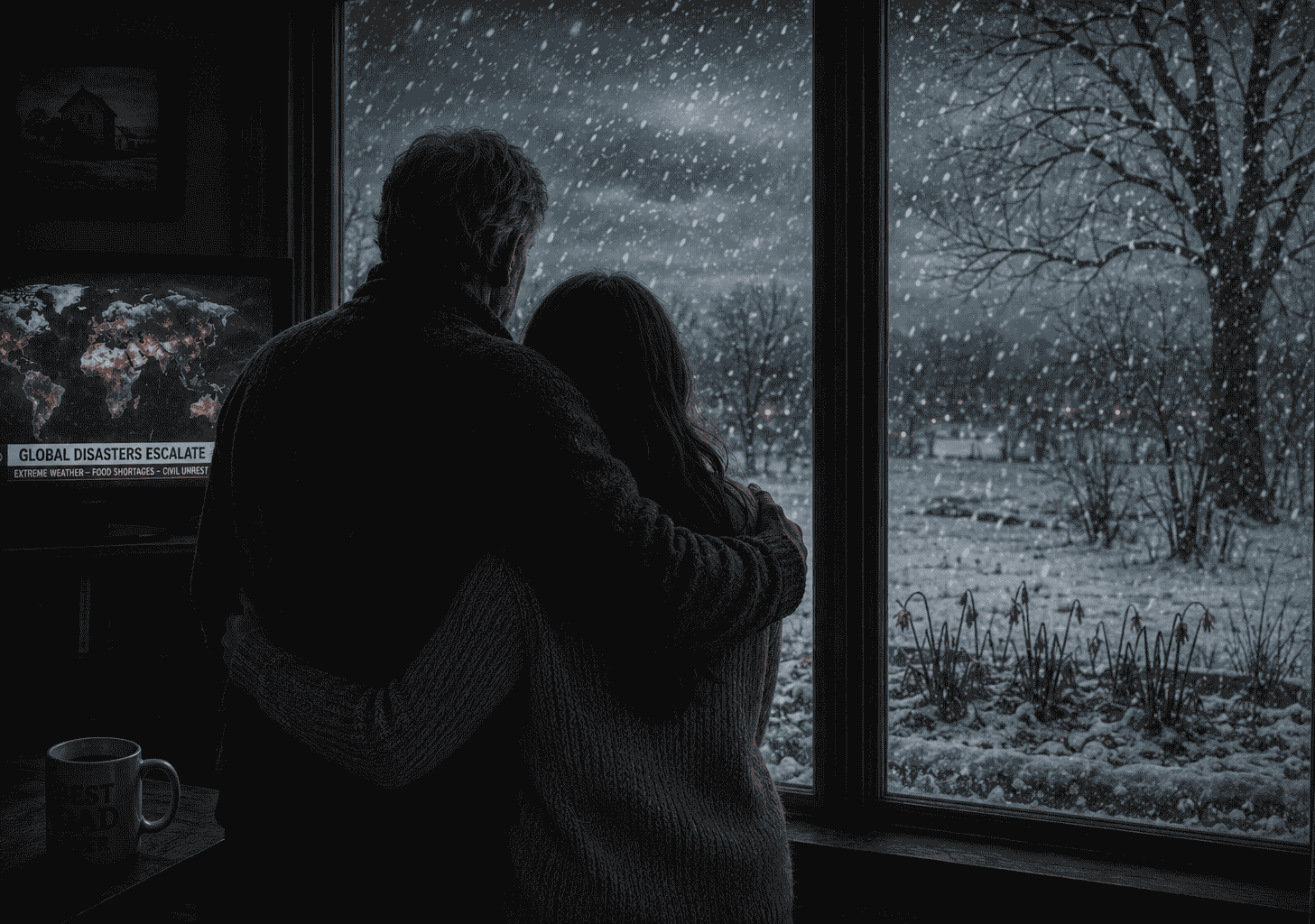
In September, Rayford stood at the window and watched the snow drift silently through the barren maple trees and settle on the flower bed where the daffodils once bloomed. “It’s beautiful,” he whispered.
“It is,” Emma agreed, “but it shouldn’t be.”
After a long silence, staring at the falling snow, he spoke in a subdued voice.
“You know, I spent most of my life telling people that human beings couldn’t possibly change the climate.”
Emma waited.
“But I was wrong. There’s no denying it anymore.”
She looked away from the wintry scene and gazed into her father’s eyes. “It’s okay, Dad. We all know now.”
He nodded, his eyes wet, and looked back at the falling snow. “We caused this. We ruined the world. But not with our cars. Our bombs.”
Emma slipped her arms around her father’s waist and hugged him tight. “I love you, Daddy. Whatever happens, we will always have each other.”
They held each other close and watched the snow fall in silence, the truth too hard to bear. There was nothing left to deny, and no one left to blame.