
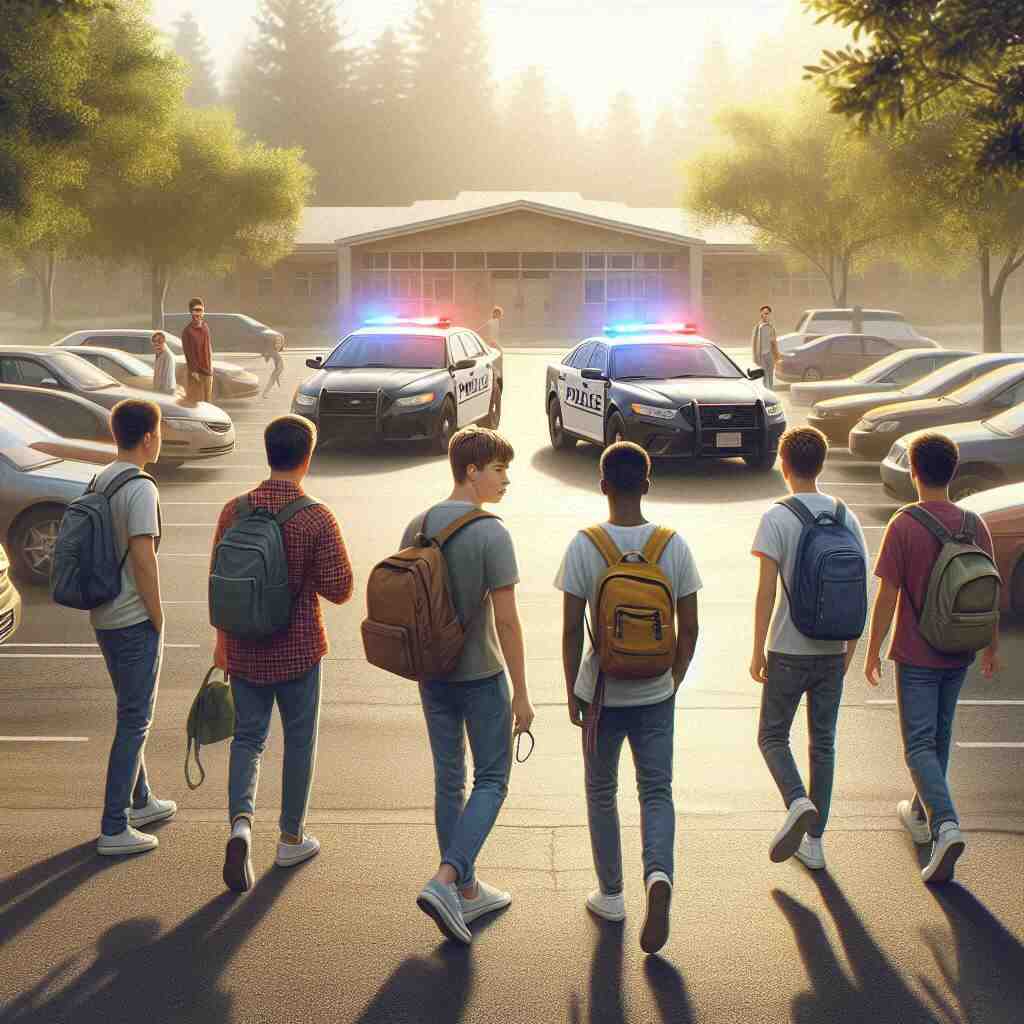
One warm September afternoon, Jake Salsa, quarterback of the high school football team, walked with his teammates to the student car lot after a bruising two-hour practice in the blazing sun. They laughed and joked about the things all high school boys do, like who the hottest girls were, who had the fastest cars, and which sports teams were the best, not necessarily in that order.
Wailing sirens and screeching tires shredded the air as police cars skidded to a stop at the curb, red and blue lights flashing.
Several uniformed police officers jumped out and approached the group of startled teenagers, guns drawn, commands sharp. “Freeze!” they shouted. “Hands in the air!”
The boys looked at each other as their hands shot skyward.
“Which one of you is Jake Salsa?” asked an officer wielding a large black handgun.
“That’s me,” Jake stammered. “How can I help you, officer…”—he looked at his nametag—“Officer Taggert?” He forced a smile. “Can I get you tickets for our home game next Friday?”
His friends, their hands still high in the air, snickered.
Officer Taggert frowned. “This is no joke, young man. This is deadly serious. I need to search your backpack. Please lay it on the ground and step back.”
“Hey wait, wait, what’s this all about, sir? This bag is my personal property. You can’t just search it without a warrant.”
“We have probable cause to search. Please do as I ask,” said the officer. “I’ll explain it shortly.”
He motioned to Jake’s companions nearby. “Okay, boys, you can lower your hands. You are free to go.” They walked a few yards away and stopped to watch.
Jake dropped his backpack onto the pavement and stepped away. A second officer—“Brown,” according to his nametag—stepped forward and patted him down. Brown removed the phone and car keys from his pockets, then pulled his arms behind his back and handcuffed him.
“You’re cuffing me? I didn’t do anything wrong.”
“Sorry to do this, but it’s only while we search your backpack.”
Officer Taggert pulled on latex gloves, unzipped the backpack and removed the contents: a laptop and charger, a couple of textbooks, a water bottle, a pack of gum, and a crumpled Doritos bag with a few chips inside.
He turned the Doritos bag over in his hands and inspected it closely, his brow furrowed. He shook his head and motioned the other officers over to look. “What do you think?” he asked.
They huddled as Jake waited anxiously a few yards away, his wrists pinched under the cuffs. After a few moments of talk and nervous laughter, a couple of officers got in their cars and drove away, leaving Taggert, Brown, and a female officer with the nametag Taylor.
Officer Brown released the handcuffs from Jake’s wrists.
“What was all that?” Jake demanded as he rubbed his numb wrists to regain feeling. “I’ve never been arrested before, officer. Why did you cuff me?”
Officer Taggert cleared his throat and managed a thin smile. “I’m sorry, son, but we had to follow protocol. It’s for your safety as well as ours.”
Jake scowled. “Well I didn’t feel very safe.”
“Again, I’m sorry,” the officer replied. “Let me tell you what happened. You’re not going to believe it.”
“Try me,” snapped Jake. “I can’t believe you arrested me for nothing. Does this have to do with those stupid new AI cameras that are always spying on us?”
“Perhaps,” said Taggert. “The school’s security system identified an item in your backpack as a gun, and we were dispatched to check it out.”
“Sure,” said Jake, “but why did you have to come in all cowboy, yelling and pointing your guns at us like we’re terrorists? How can you guys mistake something in my backpack for a gun?”
“It was a false positive.”
“Yeah, no kidding.”
“I know you’re upset. Apparently, the camera identified the Doritos bag as a gun shape and triggered the alarm.” Taggert rolled his eyes. “So much for smart cameras.”
“What are you going to do about it?” asked Jake.
“We’ll require that the school deactivate it until it’s fixed.”
Jake ran his fingers absently through his hair. “Man, oh man, this is crazy. It happened so fast. I can’t believe you almost shot me for having a bag of tortilla chips.”
Jake let out a deep sigh and locked eyes with Taggert. “You know, things happen. I get it.” He extended his hand to Taggert. “No hard feelings, you’re just doing your job.” Officer Taggert nodded and grasped his hand in a firm shake.
“And thanks for not shooting me before you searched my bag. I prefer non-lethal, lead-free air conditioning.”
Officer Taggert chuckled. “I’m glad you can find some humor in this. I know it was stressful.”
He handed Jake a card. “Call me if you have questions. You’re free to go.”
Officer Taggert turned to leave with officers Brown and Taylor, then looked back at Jake and winked. “Oh, and watch out for those Doritos bags,” he deadpanned. “I hear they can be dangerous.”
“Will do.” Jake laughed and gave a smart salute as the officers got into their cars and drove away. He joined his sidelined teammates, who whooped and high-fived and slapped him on the back.
And for the rest of the school year, all of his classmates teased him about being the most notorious criminal in town—the “Dorito Bandito.”